Medicare for RV Travel: What Seniors Should Know
Medicare’s fee-for-service option generally travels nationwide. Private plans offered through Medicare can limit routine care outside their networks. For seniors planning RV trips, provider access matters more than whether the next campground is across a state line.
Care abroad follows Medicare’s foreign-travel rules, which leave most overseas treatment uncovered. Start with how your plan handles everyday appointments, then build your camping route around the care you need.
Key Takeaways for Senior RVers
- Medicare’s fee-for-service option generally offers nationwide access to providers who accept Medicare.
- Private plans offered through Medicare cover emergency and urgently needed care, but routine care can depend on networks and service areas.
- Prescription access, legal residence, and extended absences deserve attention before a long camping season.
- Foreign treatment, medical evacuation, and getting your RV home are separate coverage questions.
Choose Medicare Coverage That Fits Your RV Travel
Original Medicare offers broader provider access
Parts A and B generally let you use Medicare-participating providers nationwide without a regional network. That often means fewer complications for full-time RV living or trips through several states.
Still, broad access doesn’t mean every bill is paid. Part B generally leaves you with 20% coinsurance after its deductible. Original Medicare has no annual out-of-pocket limit.
A Medicare supplement (Medigap) policy can help with covered cost-sharing, while a separate Part D plan handles prescriptions. Outside protected enrollment periods, buying Medigap may involve medical underwriting, depending on state rules. Keep that in mind before dropping existing coverage.
Medicare Advantage needs a closer route match
Medicare Advantage HMOs generally restrict routine care to their networks, apart from limited exceptions. PPOs generally allow out-of-network care at higher costs.
Emergency care and urgently needed services are covered when you’re away from home. Plans cannot require prior authorization before emergency treatment. Once you’re stable, follow-up appointments may fall under different network rules.
For part-time RV living near your home region, that arrangement may be manageable. A snowbird spending months elsewhere needs more room for routine care. Compare premiums, copayments, provider access, and the plan’s annual spending limit together. A low premium tells only part of the story.
Keep Your Home Base and Enrollment Dates Straight
Domicile affects more than your mailing address
Your legal residence affects available Part D and other private plans offered through Medicare. It can also affect taxes, vehicle registration, voting, and other benefits.
A mail-forwarding address doesn’t automatically establish legal domicile. For full-time RVers, those are separate decisions. A licensed insurance counselor familiar with traveling retirees can explain coverage choices tied to your actual residence.
Extended absences can also affect enrollment in these private Medicare plans, even when you keep the same address. A long camping season isn’t always treated like a short vacation.
Review coverage before October 15
Complete your annual Medicare review before October 15, using the following year’s plan documents. Annual Enrollment runs October 15 through December 7, with changes generally effective January 1.
During annual enrollment, compare prescription formularies, pharmacy networks, premiums, and provider access against your planned route. If you’re traveling during enrollment, keep plan notices accessible through dependable mail delivery or secure online accounts.
The right retirement RV lifestyle leaves room for paperwork, too.
Put Medical Stops on Your Camping Route
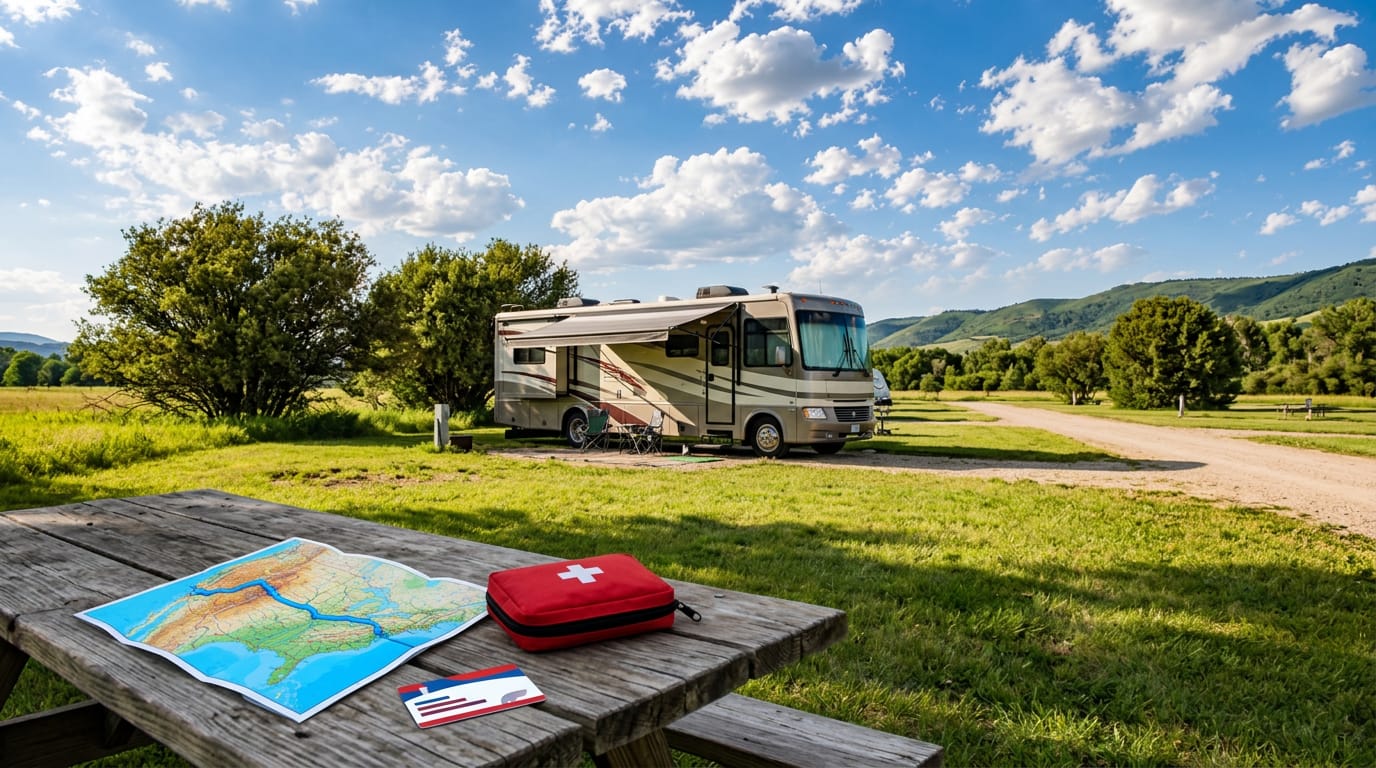
Good RV travel planning starts with appointments, not reservations. Put lab work, specialist visits, treatment, and refill dates on one calendar before picking longer stays.
Use Medicare Care Compare to locate providers who accept Medicare’s fee-for-service option. For private network plans offered through Medicare, use your plan’s directory to find in-network clinics near planned stops. The Evidence of Coverage explains referral, authorization, and out-of-area rules.
Build a small care map for each extended stay:
- Save the nearest hospital, suitable urgent care clinic, and network pharmacy offline.
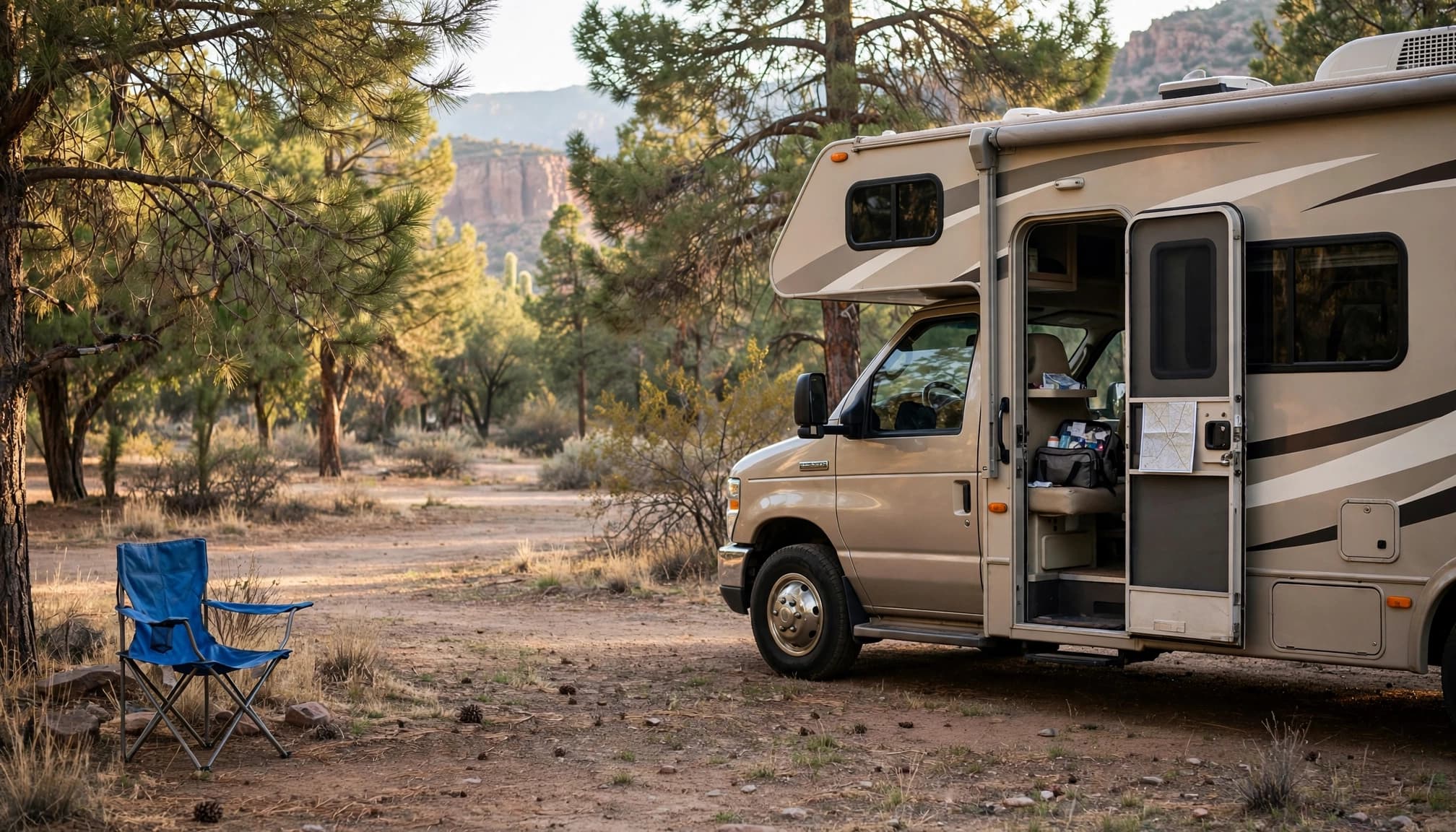
- Keep diagnoses, allergies, medication dosages, insurance cards, and emergency contacts in an accessible folder.
- Record the campground address, site number, and entrance directions for a possible 911 call.
Our guide to planning medical appointments on the road helps fit care dates around driving days.
For senior RVers new to camping, established campgrounds near needed services usually make early trips easier. Leave flexible days around important appointments. A tire problem shouldn’t force you to miss treatment.
Keep Prescriptions Ready for Travel Days

Use a pharmacy network that follows your route
Part D prescription drug coverage depends on pharmacy networks; preferred pharmacies may offer lower costs. A familiar chain name alone doesn’t guarantee preferred pricing.
Request a 90-day supply when your plan allows it, and ask whether your prescription drug plan permits out-of-area refills or early fills. CVS and other national chains can often transfer eligible prescriptions, but controlled medications and state laws can limit transfers.
Keep medicine within its labeled temperature range, away from hot vehicles and outside compartments. Our senior RV packing checklist keeps health essentials ahead of optional camping accessories.
Separate travel vaccines from foreign prescriptions
Medicare drug plans don’t cover prescriptions purchased outside the U.S. Bring enough medication for the planned trip and possible delays, within applicable border rules.
Part D covers ACIP-recommended adult vaccines without a copayment or deductible when the recommendation applies to you. Travel examples include yellow fever, chikungunya, and Japanese encephalitis vaccines.
A travel-medicine clinician can match recommendations to your age, health, and destination. Vaccination coverage doesn’t mean medical treatment abroad is covered.
Know What Ambulances and Wheelchairs Actually Cover
Medicare Part B covers medically necessary ambulance transportation when using another vehicle could endanger your health. It generally pays for transport to the nearest appropriate facility, not your preferred hospital back home.
After the applicable deductible, you generally pay 20% of the Medicare-approved amount. Air ambulance coverage requires medical necessity, too. Distance alone doesn’t qualify you for a flight.
Wheelchair vans and ordinary rides to appointments generally aren’t covered by Original Medicare. Some private plans offered through Medicare include transportation benefits under their own rules.
Wheelchairs are a separate benefit. The durable medical equipment benefit may cover prescribed, medically necessary equipment through an enrolled supplier when requirements for use in the home are met. Difficulty walking around a campground alone doesn’t establish eligibility.
Medicare also doesn’t retrieve your motorhome after an illness. Our RV medical emergency plan includes practical arrangements for the people and vehicle left at camp.
Outside the U.S., Coverage Becomes Much Narrower
For Medicare purposes, the U.S. includes all 50 states, Washington, D.C., Puerto Rico, the U.S. Virgin Islands, Guam, the Northern Mariana Islands, and American Samoa. Everywhere else counts as foreign travel.
Medicare’s fee-for-service coverage usually doesn’t cover foreign care. These limited exceptions matter for cross-border RV road trips and cruise excursions:
- An emergency starts inside the U.S. A foreign hospital must be closer than the nearest U.S. hospital capable of treating your condition.
- You’re traveling through Canada between Alaska and another state. The emergency must occur during travel without unreasonable delay along the most direct route. The Canadian hospital must be closer than the nearest suitable U.S. hospital.
- You live near a foreign hospital. If you live in the U.S. and that hospital is closer to your home than the nearest U.S. hospital capable of treating you, hospital care may qualify without an emergency.
- You receive qualifying cruise-ship care. Part B may cover medically necessary services when the doctor is legally permitted to provide them. The ship must be in a U.S. port or no more than six hours from one when services are provided, under Medicare’s cruise-ship coverage conditions.
An emergency during an ordinary camping vacation in Canada or Mexico doesn’t automatically qualify for Medicare payment.
The location and circumstances must fit a covered exception. Being close to the border isn’t enough by itself.
Handle Foreign Bills and Travel Protection Separately
Covered hospital care still has conditions
For qualifying foreign hospital care, Part A requires a formal inpatient hospital admission on a doctor’s order. The separate outpatient benefit covers eligible doctor and ambulance services immediately before and during the covered stay.
Usual deductibles and coinsurance apply. Medicare generally won’t pay for a return ambulance trip home or for ambulance and doctor services outside the hospital after the covered stay ends.
Foreign hospitals aren’t required to file Medicare claims. If yours doesn’t, submit an itemized bill for doctor, inpatient, and ambulance services, following Medicare’s foreign-care claim instructions. Keep receipts and treatment records together.
Travel insurance fills different gaps
Medicare isn’t travel insurance. It doesn’t provide general trip cancellation, overseas evacuation, or RV-return protection.
Certain Medigap policies cover 80% of qualifying foreign emergency charges after a $250 deductible. That benefit generally applies during the first 60 days of a trip and has a $50,000 lifetime limit. Private plans offered through Medicare may offer foreign emergency benefits, but coverage varies by plan.
Travel medical and evacuation policies have separate exclusions, pre-existing-condition rules, and transport limits. For RV travel on a fixed income, separate these costs in the budget. They protect against different bills.
Common Questions About Medicare on the Road
Can telehealth replace appointments while camping?
Sometimes, but it’s not a dependable replacement for every visit. Coverage rules, the type of service, and the clinician’s authority to treat you where you’re physically located all matter.
Keep a dependable connection available. Hands-on exams, imaging, and procedures still require an appropriate care location.
Can I add Medigap to Medicare Advantage?
No. Medigap works with Medicare Parts A and B and cannot pay Medicare Advantage copayments or deductibles.
Returning to Medicare’s fee-for-service option doesn’t automatically guarantee access to a Medigap policy. Enrollment protections and state rules matter.
Keep Your Coverage as Manageable as Your Route
Medicare for RV travel works more smoothly when provider access, prescriptions, and your home base fit the way you camp. Routine care deserves as much planning as emergencies.
Before your next senior camping trip, put care dates on the calendar and save nearby treatment options. A little preparation leaves fewer decisions for a difficult day.